

DNP - Doctor of Nursing Practice
 Hybrid Format
 Among the best in the U.S.
 Financial Assistance Available
 Expansive career opportunities
At a Glance
Best Suited For
- The BSN-to-DNP pathway is for nurses who have earned a BSN or generalist MSN degree who hope to become advanced practice nurses (APRNs), specialize in a particular area of practice, and achieve the highest level of nursing practice. Beginning with students matriculating in Fall 2027, applicants must have one year of full-time RN work experience by the time they begin the program, typically in the fall.
- The MSN-to-DNP pathway is for practicing APRNs to earn a DNP and advance their careers.
Degree
The Doctor of Nursing Practice (DNP) degree is obtained through both the BSN-to-DNP and MSN-to-DNP pathways.
Certification
The BSN-to-DNP pathway also prepares students for national specialty certification in one of seven advanced practice registered nurse (APRN) concentrations:
- Adult-Gerontology Acute Care Clinical Nurse Specialist (AGACNS)
- Adult-Gerontology Acute Care Nurse Practitioner (AGACNP)
- Family Nurse Practitioner (FNP)
- Neonatal Nurse Practitioner (NNP)
- Pediatric Acute Care Nurse Practitioner (PNP-AC)
- Pediatric Primary Care Nurse Practitioner (PNP-PC)
- Psychiatric-Mental Health Nurse Practitioner (PMHNP)
Program Format
Hybrid- enjoy the flexibility of online learning while staying connected through in person sessions.
Length of Program
- BSN-to-DNP- full-time, 3-year plan of study
- MSN-to-DNP- full-time, 2-year plan of study or part-time, 3-year plan of study
Application Deadlines
- Application open: Jul. 1
- Application deadline: Jan. 5
- Decisions announced: First week of March
Career Outcomes
- APRNs with an enhanced skill set
- Leadership positions in health organizations
- Directors of clinical nursing at health facilities and systems
- Academic faculty positions
Cost
See Tuition and Fees below
Financial Aid
APRN Clinical Practicum
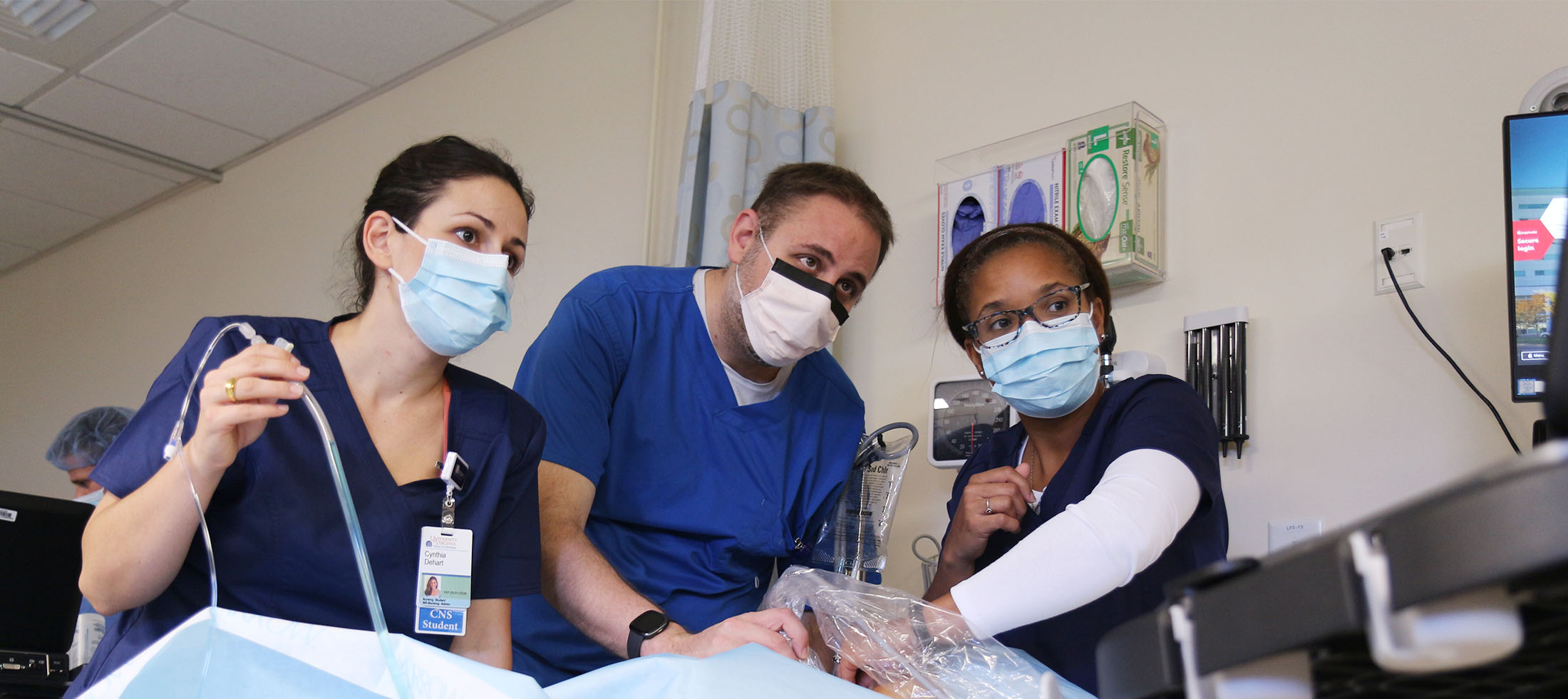
BSN-to-DNP students complete 750 required clinical practicum hours, with guidance and support in finding qualified preceptors and clinical placements.
DNP Project
BSN-to-DNP and MSN-to-DNP students receive expert faculty mentorship throughout their DNP project where students will address a documented need that aligns with their professional interests at a clinical practice site.
Frequently Asked Questions
See FAQ below
The Ultimate Advanced Practice Nurse
The Advanced Practice Registered Nurse (APRN) with a Doctor of Nursing Practice (DNP) degree is prepared to practice at the highest clinical level while also leading healthcare teams and improving patient care, safety, and healthcare systems. In addition to making treatment decisions, ordering diagnostic tests, and prescribing medications, DNP-prepared nurses take on leadership roles across healthcare, academia, administration, and public policy. Career opportunities include advanced clinical practice, nurse administration, teaching and professorships, government affairs, and executive leadership, such as chief nursing officer.
The UVA School of Nursing offers two pathways to earn a DNP, designed to meet nurses at different stages of their careers:
-
BSN-to-DNP: Designed for nurses with a Bachelor of Science in Nursing (BSN) or a generalist Master of Science in Nursing (MSN) who want to become advanced practice nurses, specialize in a particular area of practice, and earn the highest practice-focused degree in nursing. Beginning with students matriculating in Fall 2027, applicants must have one year of full-time RN work experience by the time they begin the program, typically in the fall.
-
MSN-to-DNP: Designed for practicing advanced practice registered nurses (APRNs) who want to earn a DNP, advance their careers, and deepen their expertise in a particular area of practice.
UVA School of Nursing alumni are eligible for guaranteed admission.
BSN-to-DNP Specialty Concentrations


Students who attend UVA are mentored by faculty members who are experts in their field as educators, clinicians, researchers. Their experiences are additionally enriched by access to other disciplines across the University, including religion, ethics, contemplative sciences, mindfulness, and medicine. All graduate nursing students are required to have a laptop.
Though it depends on the degree with which students enter the program (whether it's a BSN or MSN), as well as the specialty area DNP students choose, core courses typically include:
DNP Core Courses (29 credits)
- GNUR 8180: Healthcare Data Analysis (3 credits)
- GNUR 8620: Quality and Safety in Healthcare Systems (4 credits)
- GNUR 8645: Ethics and Leadership in Interprofessional Practice (3 credits)
- GNUR 8650: Information Systems and Patient Care Technology (3 credits)
- GNUR 8660: Evidence-Based Practice (3 credits)
- GNUR 8680: Culturally Sensitive Care/Population Health (3 credits)
- GNUR 9026: Health Policy, Economics & Finance (3 credits)
- GNUR 9027: Practice Change Management (2 credits)
- GNUR 9710: Implementation of Practice Change (3 credits)
- GNUR 9720: Dissemination of Practice Scholarship (2 credits)
- Electives (9 credits)
BSN to DNP Program Specialty Track Concentration Courses
Specialty track courses (22-26 credits)
BSN to DNP students may choose from one of seven concentrations:
- Adult-Gerontology Acute Care Clinical Nurse Specialist specialty
- Adult-Gerontology Acute Care Nurse Practitioner specialty
- Family Nurse Practitioner specialty
- Neonatal Nurse Practitioner specialty
- Pediatric Nurse Practitioner - Acute Care specialty
- Pediatric Nurse Practitioner - Primary Care specialty
- Psychiatric-Mental Health Nurse Practitioner specialty
A dual-track Adult Gerontology Acute Care CNS + NP specialty is a full-time program and for military students only.
APRN Clinical Practicum
All BSN-to-DNP students complete 750 hours (14 credits) of direct care practicum.
Clinical requirements do not need to be met at the UVA Medical Center; the School has existing clinical contracts across the Commonwealth and in Washington DC and Maryland. We guarantee practicum placements within the state of Virginia; however, there are certain sites within Virginia that we are unable to secure due to factors such as site capacity, affiliation limitations, or specialty availability. While we cannot guarantee out-of-state placements at any point during your program, over the past three years we have successfully arranged practicum experiences both within Virginia and in nearby states, including North Carolina, Washington, D.C., and Maryland.
Clinical placement is a collaborative process that considers your professional connections in conjunction with program requirements and available clinical opportunities. Professional connections may help identify potential clinical sites or preceptors; however, the program will work with you to evaluate and finalize the clinical placement to ensure all requirements are met.
DNP Project
The DNP program culminates in the successful completion of a DNP project—a significant, evidence-based contribution to existing nursing knowledge suitable for publication in a peer reviewed journal or a book—designed by the student in collaboration with a project team.


Frequently Asked Questions (FAQ)
No. Our DNP program is offered in a hybrid modality. We combine face-to-face and online learning experiences to allow students to engage with course content, faculty and peers through both in-person and virtual learning environments.
In-person class requirements vary by semester and APRN specialty. For example, in semesters with lab and APRN practicum requirements, students may be required to come in-person to UVA School of Nursing for 2-4 consecutive days for intensive labs.
In semesters without lab and practicum requirements, students have in-person classes on average 4-5 times a semester.
In person requirements are published up to 4 months prior to the semester.
For the BSN-to-DNP pathway, the full-time program takes 3 years to complete. The part-time program, only available to a limited number of students, takes 5 years to complete.
For the MSN-to-DNP pathway, the full-time program takes 2 years to complete, and the part-time program takes 3 years to complete.
No. To ensure progression, we ask that students follow the published plan of study.
Students enrolled in the full-time program should carefully consider the demands of maintaining employment while pursuing their degree. Full-time study, specifically in the final year of the program, requires significant engagement in coursework, clinical experiences, and group projects. Course schedules, clinical placements, and academic requirements may vary by semester.
Although some students successfully maintain employment during the program, doing so can present challenges related to time management, academic performance, personal wellbeing, and work-life balance. Students are encouraged to evaluate their professional and personal commitments and develop a realistic plan to support their academic success.
Students enrolled in the part-time program often have greater flexibility to work while in the program. However, the final year of the part-time program is full-time (9 credit hours) as students are enrolled in practicum and completing their DNP project.
DNP students may be eligible to transfer a maximum of 12 credits total from other academic institutions or from other UVA programs prior to admission if they meet the criteria outlined in the transfer credit policy. All transfer credit requests are reviewed and approved by the Graduate Program Lead after the student has matriculated.
Clinical placement is a collaborative process that considers your professional connections in conjunction with program requirements and available clinical opportunities. Professional connections may help identify potential clinical sites or preceptors; however, the program will work with you to evaluate and finalize the clinical placement to ensure all requirements are met.
Each student is responsible for identifying and developing an individual DNP project that addresses a documented practice-site need and aligns with their professional interests. The School may assist students in identifying potential project opportunities and facilitating connections with practice sites based on organizational priorities, project feasibility, academic appropriateness, and available site support. All proposed projects, whether independently identified or developed with School assistance, must meet established academic and organizational approval requirements.
A DNP degree is a doctorate of nursing practice. A PhD is a research doctorate.
Graduates of PhD programs are prepared to conduct independent research and disseminate their findings. PhD graduates are preferred for academic faculty positions, but DNP graduates are also recruited for academic and leadership positions emphasizing evidence-based clinical practice and teaching.
A DNP will provide graduates with the skills and tools necessary to assess the evidence gained through nursing research, evaluate the impact of that research on their practice and, as necessary, make changes to enhance quality of care.
Scholarship is an integral part of both doctoral degrees.
| DNP | PhD |
|---|---|
|
Focus: Nursing practice |
Focus: Nursing research |
|
Goal: To perform at the highest level of nursing practice; assume leadership roles in healthcare delivery systems; critically appraise existing literature and evidence to determine and implement best practices; and improve patient outcomes by expanding knowledge of evidence-based practice. |
Goal: To prepare scholars with expertise in selected substantive areas to contribute to nursing theory and practice through systematic inquiry. |
|
Focus of courses:
|
Focus of courses:
|
|
Point of entry:
|
Point of entry:
|
|
Length of program: 3 to 5 years |
Length of program: 3 to 7 years |
|
Clinical requirements: 750 clinical hours (BSN to DNP) |
Clinical requirements: none |
|
Scholarship opportunities:
|
Scholarship opportunities:
|
|
Job prospects after graduation:
|
Job prospects after graduation:
|
Want to learn more?